Five examples, five useful ideas.
Follow each exact result, then try the same pattern with your own numbers.
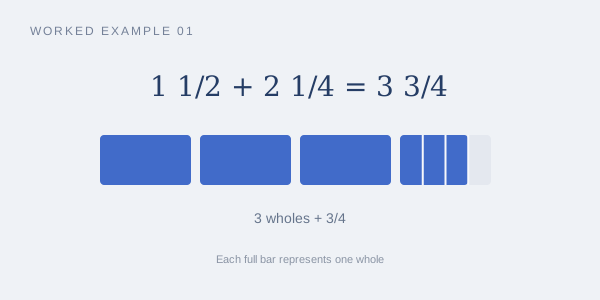
01Unlike fractional parts
Convert to three halves and nine quarters. Using quarters gives 6/4 + 9/4 = 15/4. Three complete groups of four leave three quarters.
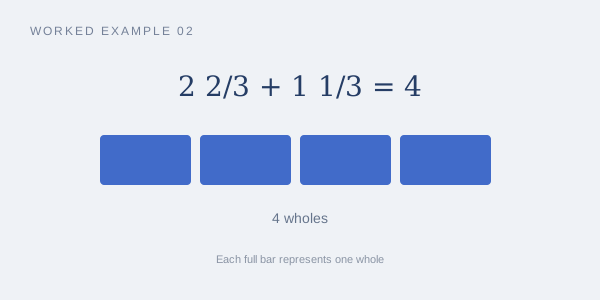
02A whole-number result
The fractional parts add to one whole. Together with the three original wholes, the result is four. A correct answer does not need a leftover fraction.
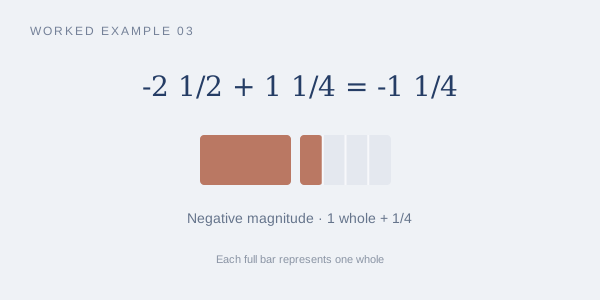
03Negative mixed numbers
The sign applies to the entire first value. Negative ten quarters plus five quarters leaves negative five quarters, which is negative one and one quarter.
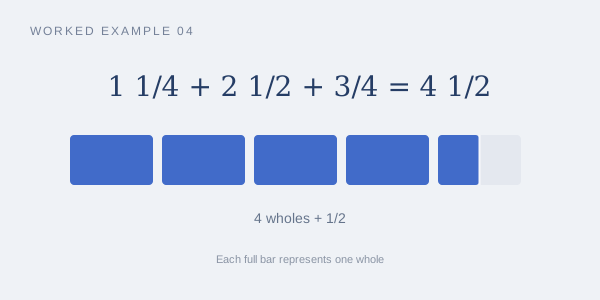
04Three-number addition
Express all three values in quarters: 5/4 + 10/4 + 3/4 = 18/4. Reduce before writing the final mixed form, four and one half.
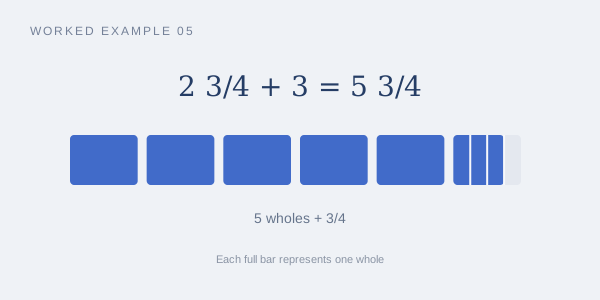
05Mixed number and whole number
A whole number can be written with denominator one. Adding three to two and three quarters changes the whole part while leaving the three quarters unchanged.

What a mixed fraction represents
A mixed fraction combines a whole-number part with a proper fraction. The notation 2 3/4 means 2 + 3/4, not two multiplied by three quarters. Mixed numbers are useful when a quantity is a little more than a whole number, such as a ribbon length or an amount in a recipe. The space in the written notation carries an important meaning.
This mixed fraction calculator treats each entry as a single signed quantity. It converts the entry to an improper fraction before carrying out an operation. That conversion removes any ambiguity about how the whole and fractional parts interact. You can still read the final answer as a mixed number, because the result panel converts it back after simplifying.
How to use the mixed fraction calculator
Enter the first value in the form whole numerator/denominator, for example 3 2/5. Select addition, subtraction, multiplication, or division, then enter the second value. Press Calculate to update the result and the working. The example buttons fill the fields and calculate a complete demonstration, making it easy to compare a familiar problem with your own.
You may also enter a plain fraction, an integer, or a decimal. For three quantities, add the third input. The mixed fraction calculator applies the selected operation to all entries from left to right. It does not combine several different operation signs in a single field. If your exercise has parentheses, work through the parentheses first and reuse the exact fraction result.
Convert once, then apply the correct rule
To convert a positive mixed number to an improper fraction, multiply the whole part by the denominator and add the numerator. Keep the original denominator. Thus 3 2/5 becomes (3 × 5 + 2)/5, or 17/5. Each whole contains five fifths, so the calculation is counting equal-sized pieces rather than changing the value.
Addition and subtraction then require equal denominators. Multiplication can use cross-cancellation before multiplying. Division uses the reciprocal of the divisor. The mixed fraction calculator shows the relevant rule rather than asking you to use the same process for every operation. In particular, you should never multiply only the whole parts and only the fraction parts as two isolated calculations.
Regrouping is about exchanging one whole
When adding mixed numbers, the fractional result may reach or exceed one. For example, two thirds plus one third makes a complete whole, which joins the existing whole-number total. In subtraction, the fractional part of the first number may be too small. You can exchange one whole for denominator-sized pieces before subtracting.
The dedicated subtraction tool shows that borrowing explicitly when both inputs are nonnegative and the first value is at least the second. For negative differences, the improper-fraction method keeps the signs clearer. Both methods describe the same arithmetic. Use the mixed fraction calculator to check the result, then choose the written method that best matches the question or lesson.
Keep negative signs and answer forms clear
A negative mixed number has a single sign covering its complete magnitude. The input -2 1/2 represents negative two and a half, so it converts to -5/2. Adding a positive amount moves that value toward zero; subtracting a positive amount moves it farther below zero. Parentheses around a negative value can help when copying an equation onto paper.
The mixed fraction calculator returns a reduced fraction as well as mixed form. If the magnitude is below one, the answer stays a proper fraction. If no remainder exists, it becomes a whole number. Decimal parentheses indicate an exact repeating block. A truncated decimal preview is labelled approximate and must not be confused with the exact rational result.
Use the specialist pages for a focused lesson
If your only task is changing a representation, choose a conversion page instead of setting up an arithmetic problem. The improper-fraction converter separates complete wholes from the remainder. The reverse converter counts all fractional pieces in one numerator. The decimal tools connect those ideas to place value, long division, and repeating digits.
If you are practising one operation, use its dedicated tool for a more focused explanation and examples. The parent mixed fraction calculator remains the place to switch between operations or combine three quantities. This division of tasks lets you start with the question you actually have, without first learning unrelated fraction procedures.
Common questions
Is a mixed number different from a mixed fraction?
In this context the two names describe the same notation: a whole number followed by a fraction. Mixed fractions calculator and mixed number calculator searches usually ask for the same arithmetic task. The important distinction is between that combined notation and an improper fraction with a single numerator.
Can I use a mixed fraction calculator with whole numbers?
Yes. Enter an integer such as 3 directly in a field. Internally it equals 3/1. You can combine it with a mixed number or a plain fraction without adding a fake zero fraction. The displayed steps show the rational value used in the operation.
Can the fractional part be improper?
Yes. An entry such as 2 7/4 is interpreted as 2 + 7/4 and normalized to 3 3/4. This is not standard final mixed-number notation, but its meaning is well defined. The result always uses a proper fractional remainder after simplification.
Do I need to reduce the answer myself?
No. The mixed fraction calculator reduces the numerator and denominator by their greatest common divisor. You can still inspect the intermediate common-denominator or multiplication step. Seeing a larger fraction during the working is normal; simplification belongs after that arithmetic or in a valid cross-cancellation step.