Five examples, five useful ideas.
Follow each exact result, then try the same pattern with your own numbers.
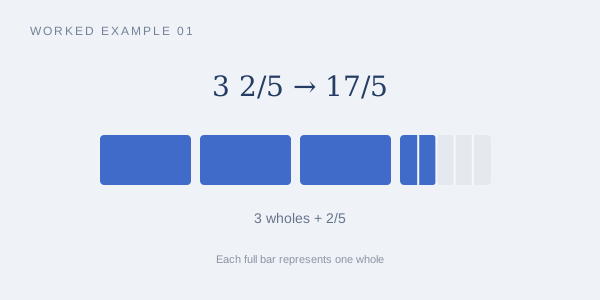
01Count fifths
Three complete wholes contain fifteen fifths. Add the remaining two fifths to get seventeen fifths, written as 17/5.
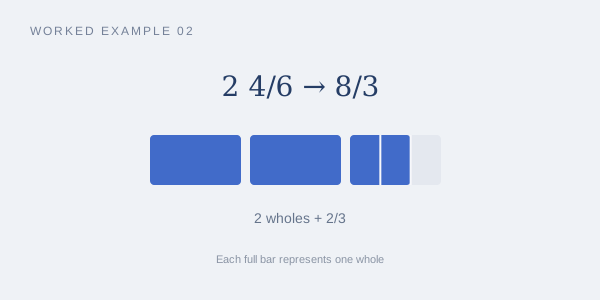
02Reduce an equivalent result
Two and four sixths is sixteen sixths. Dividing numerator and denominator by two gives eight thirds, the reduced improper fraction.
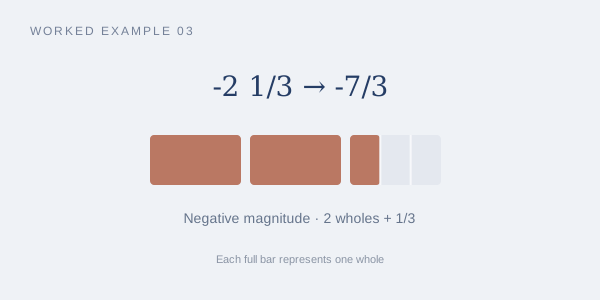
03Apply the sign to everything
Two and one third contains seven thirds. The leading minus sign makes all seven thirds negative, giving -7/3.
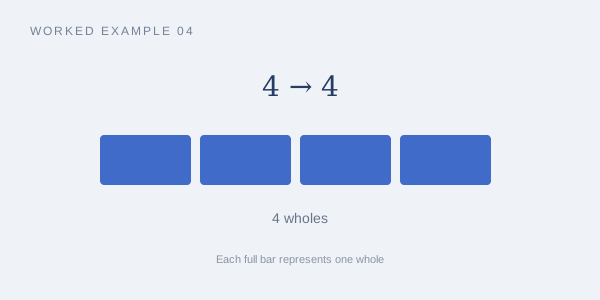
04Convert a whole number
A whole number can be written over one: four is 4/1. The answer panel omits the unnecessary denominator when displaying an integer.
05Normalize a large fractional part
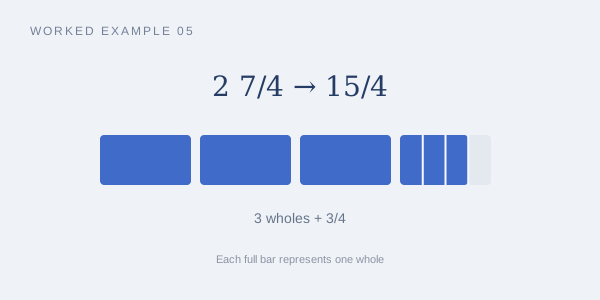
The input means two plus seven fourths. Eight fourths plus seven fourths is fifteen fourths, even though the input is not standard mixed notation.

Why combine a mixed number into one fraction?
A mixed number expresses a quantity as a whole part plus a fractional part. Three and two fifths means 3 + 2/5. An improper fraction expresses that same total using only fifths. Neither form is more exact than the other. They organize the quantity differently, and the most useful form depends on what you want to do next.
Use the mixed number to improper fraction calculator before multiplying or dividing mixed numbers, when an equation needs a single fraction, or when you want to compare values using common denominators. A single numerator makes the arithmetic rules easier to apply. You can always turn the final fraction back into a mixed number after the calculation is complete.
Multiply, add, and keep the denominator
For a nonnegative mixed number w a/b, multiply w by b, then add a. Put the result over b. The formula is (w × b + a)/b. The multiplication counts the fractional pieces inside the complete wholes. The addition includes the pieces already shown in the fractional part. The denominator continues to name the size of each piece.
For 3 2/5, each whole contains five fifths. Three wholes therefore contain fifteen fifths, and the extra two fifths bring the total to seventeen. The answer is 17/5. Do not multiply the whole number by the numerator, and do not add the whole number directly to the numerator. Both mistakes ignore the number of pieces in each complete whole.
Understand reduction in the displayed steps
The calculator reduces the rational value before showing its normalized whole and fractional parts. If you enter 2 4/6, it may explain the conversion using 2 2/3, because four sixths and two thirds are equal. The result is 8/3. Working from the unreduced input gives 16/6, which reduces to the same answer by dividing both parts by two.
Reduction is a change in representation, not a change in value. A denominator should only become smaller when its numerator is divided by the same common factor. You can verify that 16/6 and 8/3 are equal by cross-multiplying: sixteen times three and eight times six both equal forty-eight. This check is helpful when a textbook keeps an unreduced intermediate answer.
Enter negative mixed numbers unambiguously
Type -2 1/3 to mean negative two and one third. The minus sign covers the whole combined quantity, so the improper fraction is -7/3. If you instead intend negative two plus positive one third, that is an addition problem with result -5/3. Use the main arithmetic tool and enter those quantities separately so that the intended operation is explicit.
The mixed number to improper fraction calculator treats a leading sign consistently across whole numbers, mixed numbers, and plain fractions. A negative fractional numerator inside mixed notation is not accepted; put the sign at the front. Keep the fractional denominator positive when writing a conventional mixed number. These entry rules avoid ambiguous combinations of signs and make the result easier to check.
Use the result in multiplication and division
Once a mixed number is a single fraction, multiplication follows the ordinary numerator-times-numerator and denominator-times-denominator rule. For example, 1 1/2 becomes 3/2 and 2 1/3 becomes 7/3. Their product is 21/6, which reduces to 7/2 or 3 1/2. Cross-cancellation can reduce the size of the numbers before multiplying.
For division, convert both mixed numbers first and then take the reciprocal of the divisor only. Dividing 1 1/2 by 2 1/3 becomes 3/2 multiplied by 3/7, giving 9/14. Converting first prevents an incorrect attempt to divide whole parts separately from fractional parts. The dedicated multiplication and division pages show those operations with their own examples and working.
Check by recovering the original whole part
Divide the absolute numerator of the improper fraction by its denominator. The quotient should recover the normalized whole-number part, and the remainder should recover the fractional numerator. Seventeen divided by five gives three with remainder two, returning 3 2/5. Restore the leading negative sign afterward if the original value was negative.
You can also estimate the size. A positive mixed number with a proper fractional part lies between its whole part and the next integer. Therefore 3 2/5 must produce a fraction between three and four. If your computed numerator were seven over five, it would fail this bound immediately. An estimate catches many input and arithmetic errors before you need a detailed recalculation.
Common questions
Is an improper fraction an incorrect fraction?
No. Improper is the conventional name for a fraction whose positive numerator is at least its denominator. Such fractions are valid numbers and are often the best form for arithmetic. The mixed number to improper fraction calculator changes notation without correcting or altering the original quantity.
Can I enter a whole number without a fraction?
Yes. An integer is a fraction with denominator one, so four is 4/1. The interface displays four rather than an unnecessary slash-one expression. If you need a particular denominator, you can build an equivalent fraction afterward, such as 20/5, by multiplying numerator and denominator by the same number.
What if the fractional part is already improper?
An entry such as 2 7/4 is interpreted as two plus seven fourths. It produces 15/4 and normalizes to 3 3/4. This is mathematically well defined, although conventional mixed notation uses a proper fractional part. The result panel makes that normalization visible.
Does conversion change the decimal value?
No. Three and two fifths and seventeen fifths both equal 3.4. The decimal form can help check a terminating example, but use the exact fraction for repeating values. A shortened decimal display is an approximation and should not replace an exact rational value in later calculations.