Five examples, five useful ideas.
Follow each exact result, then try the same pattern with your own numbers.
01Multiply by the reciprocal
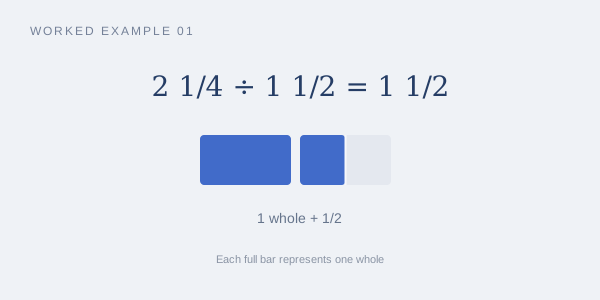
Nine fourths divided by three halves becomes nine fourths times two thirds. The quotient reduces to three halves, or one and one half.
02Count equal groups
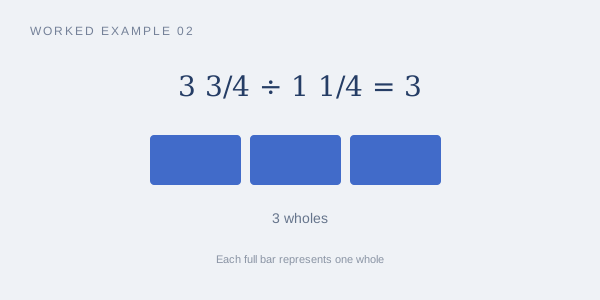
Fifteen fourths contains three groups of five fourths. The exact quotient is three, with no fractional remainder.
03Keep, change, flip
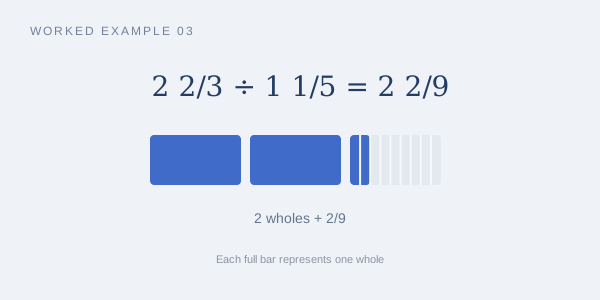
Keep eight thirds, change division to multiplication, and flip six fifths to five sixths. Forty eighteenths reduces to twenty ninths.
04Divide by a proper fraction
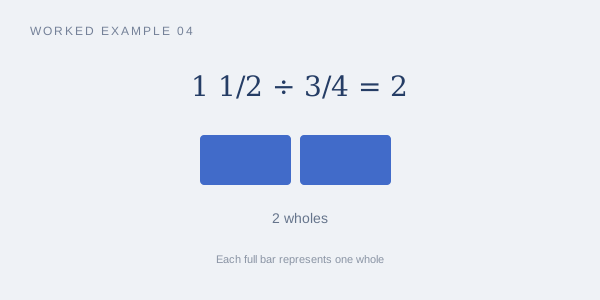
Three halves contains two groups of three quarters. Dividing by a positive number below one increases this positive dividend.
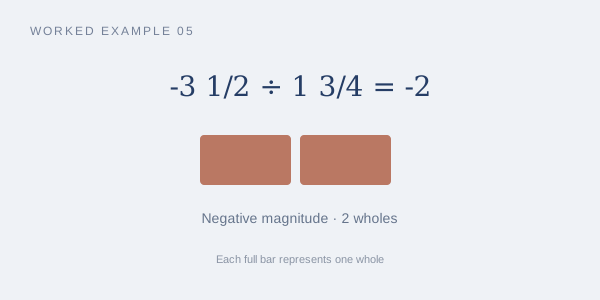
05Opposite signs
Negative seven halves divided by seven fourths becomes negative seven halves times four sevenths. The quotient is negative two.
Division asks how many groups fit
A division a ÷ b asks how many groups of size b make a, provided b is not zero. This interpretation works for fractional group sizes as well as whole numbers. If you have 3 3/4 metres of ribbon and each piece is 1 1/4 metres, the quotient is three pieces. The units cancel because both lengths use the same unit.
The dividing mixed numbers calculator places the dividend in the first field and the divisor in the second. Order matters: reversing the inputs generally changes the answer. Before calculating a measurement problem, convert the two quantities into compatible units. The calculator can compute an exact numerical quotient, but it cannot infer a missing unit conversion or decide whether leftover material can form a partial real-world item.
Convert each mixed number into one fraction
A mixed number combines a whole part and a fractional part. Convert it to an improper fraction before applying the division rule. For 2 1/4, multiply two by four and add one to obtain 9/4. For 1 1/2, multiply one by two and add one to obtain 3/2. The division is now 9/4 ÷ 3/2.
Do not divide the whole parts separately and then divide the fractional parts. That procedure does not preserve the original quantities. Converting each mixed input into one numerator-over-denominator expression includes all of its pieces and gives you a uniform rule for positive numbers, negative numbers, whole numbers, and proper fractions.
Keep the dividend and invert only the divisor
Dividing by a nonzero fraction is equivalent to multiplying by its reciprocal. The reciprocal of c/d is d/c. Keep the first fraction unchanged, change the division sign to multiplication, and invert the second fraction. For 9/4 ÷ 3/2, the resulting multiplication is 9/4 × 2/3. The dividend nine fourths is not flipped.
This rule works because a nonzero number multiplied by its reciprocal equals one. Multiplying the divisor by its reciprocal changes the divisor to one, and applying the same factor to the dividend preserves the quotient. The dividing mixed numbers calculator shows this reciprocal explicitly so that the shortcut has a visible mathematical reason rather than being only a memorized phrase.
Cancel common factors and simplify the quotient
After replacing division with multiplication, use ordinary fraction multiplication. You may cancel common factors between a numerator and a denominator before multiplying. In 9/4 × 2/3, divide nine and three by three, then divide two and four by two. The remaining product is 3/2, which becomes 1 1/2 in mixed notation.
For 2 2/3 ÷ 1 1/5, the converted division is 8/3 ÷ 6/5. Multiply 8/3 by 5/6 to obtain 40/18, reduce to 20/9, and separate two wholes with remainder two ninths. Early cancellation gives the same reduced answer. A common denominator is not required, because the actual operation after inversion is multiplication.
Understand zero, signs, and divisors below one
Division by zero is undefined. If the second input represents zero, the tool displays an error instead of an answer. Zero divided by a nonzero number is valid and equals zero. These two expressions look similar but have different meanings: there is no finite number of zero-sized groups that can reproduce a nonzero dividend.
A positive divisor smaller than one can make a positive quotient larger than its dividend. One and one half divided by three quarters equals two. For signed inputs, equal signs produce a positive quotient and opposite signs produce a negative quotient. The leading sign of a mixed number applies to the whole quantity, so -3 1/2 is negative seven halves before the reciprocal rule is applied.
Check with multiplication and interpret the remainder
Multiply the quotient by the original divisor to check the result. For 2 1/4 ÷ 1 1/2 = 1 1/2, multiplying 1 1/2 by 1 1/2 gives 2 1/4. This inverse check is exact when performed with fractions. A rounded decimal quotient may not multiply back perfectly, so keep the rational form if equality matters.
A mixed-number quotient describes a mathematical ratio, not automatically a count of complete physical objects. If a task asks how many full pieces can be cut, its answer may require the integer part and a separate leftover measurement. For example, a quotient of 2 2/9 means two complete groups plus two ninths of another group. Convert that fractional group back into the original unit before describing the leftover material.
Common questions
Why do I flip only the second fraction?
The second fraction is the divisor, so its reciprocal is the factor that replaces division. Flipping the first fraction too changes the original dividend and solves a different problem. The dividing mixed numbers calculator keeps the first fraction visible and states which reciprocal is used before multiplying.
Can division make a number bigger?
Yes. For a positive dividend, dividing by a positive number below one makes the quotient larger. You are counting smaller groups, so more groups fit. Dividing by a positive number above one makes the quotient smaller. This size check helps identify a reciprocal taken in the wrong place.
What happens if I enter zero as the divisor?
The calculator stops and explains that division by zero is undefined. It does not produce infinity, a mixed number, or a decimal answer. Change the second input to a nonzero value. Zero is allowed in the first field when the divisor is nonzero, and that quotient is zero.
Is a fractional quotient the same as leftover material?
No. The fractional part is a fraction of one divisor-sized group. To find leftover material after taking complete groups, multiply that fractional part by the original divisor. Keep the units in that interpretation. The numerical quotient alone does not tell you whether a physical task permits partial groups.