Five examples, five useful ideas.
Follow each exact result, then try the same pattern with your own numbers.
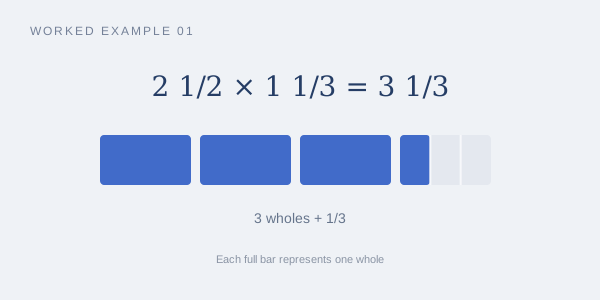
01Convert before multiplying
Five halves times four thirds is twenty sixths. Reduce to ten thirds, then separate the three whole units and one third.
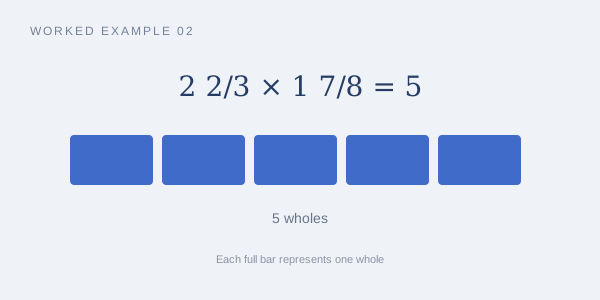
02Cross-cancel first
Eight thirds times fifteen eighths has a common factor of eight across one diagonal and three across the other. The simplified product is five.
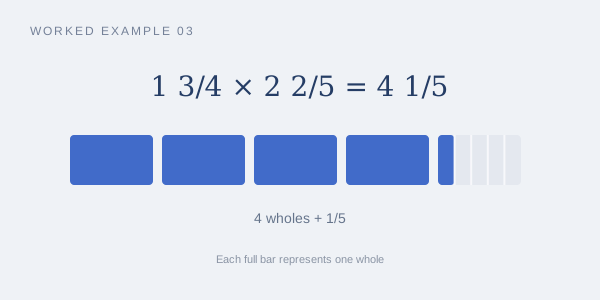
03Multiply reduced factors
Seven fourths times twelve fifths reduces to seven times three over five. The product is twenty-one fifths, or four and one fifth.
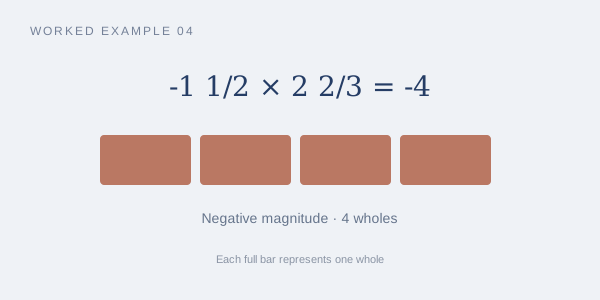
04Opposite signs
Negative three halves times eight thirds has a negative sign. Cross-cancelling three and two leaves a product of negative four.
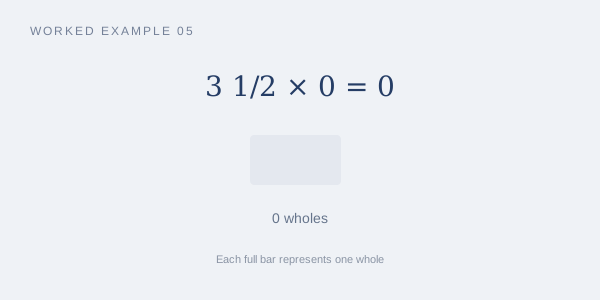
05Multiply by zero
Any finite rational number multiplied by zero equals zero. There is no fractional remainder to display.

Multiplication scales one quantity by another
Multiplying mixed numbers can describe scaling a recipe, finding a rectangular area, or applying a rate. The numerical result follows fraction multiplication, while the units depend on the situation. Multiplying a length by a length gives an area; multiplying a quantity by a dimensionless scale factor keeps the original unit. Decide what the inputs mean before interpreting the product.
The multiplying mixed numbers calculator focuses on the exact numerical operation. It accepts two mixed numbers, but either field can also contain a whole number or an ordinary fraction. The operation is fixed to multiplication here. This keeps the worked examples tied to one task and makes it easier to compare the calculator steps with a classroom multiplication method.
Convert both mixed numbers to improper fractions
A mixed number is a sum of its whole and fractional parts, so multiplying only the visible whole parts and visible fractional parts separately is incorrect. Instead, combine each input into a single fraction. Multiply its whole part by its denominator, add its fractional numerator, and keep the denominator. For 2 1/2, that gives (2 × 2 + 1)/2 = 5/2.
Convert 1 1/3 in the same way to obtain 4/3. The complete multiplication becomes 5/2 × 4/3. Every part of both original mixed quantities is now included in the numerators. This conversion prevents a missing cross-term error, which occurs if you calculate only 2 × 1 and 1/2 × 1/3 and then add those two partial results.
Multiply numerators and denominators
For fractions a/b and c/d, the product is (a × c)/(b × d), provided the denominators are nonzero. Unlike addition and subtraction, multiplication does not require common denominators. Five halves times four thirds gives twenty sixths. Dividing numerator and denominator by two reduces the result to ten thirds, which is three and one third.
The denominator changes because multiplication creates a new fractional scale. For example, one half of one third is one sixth, not one third or one half. That is why the denominators are multiplied in this operation. The multiplying mixed numbers calculator displays the converted factors and the numerator-over-denominator product so that this rule is visible in the working.
Cross-cancel to keep intermediate numbers small
Before multiplying, look for a common factor between a numerator in one fraction and a denominator in the other. Divide both by that factor. This is valid because the complete product has that factor in both its numerator and denominator. Cross-cancellation simplifies the same rational value earlier; it does not introduce a different multiplication rule.
For 2 2/3 × 1 7/8, convert to 8/3 × 15/8. The two eights cancel, and fifteen divided by three leaves five. The product is five without needing to write 120/24 first. Do not cancel two numerators against each other or cancel terms across an addition sign. Cancellation removes common multiplicative factors, not arbitrary matching digits.
Predict the size and sign of the product
Multiplication does not always make a number larger. Multiplying a positive value by a number greater than one increases it; multiplying it by a positive proper fraction decreases it. Multiplying by one leaves it unchanged, and multiplying by zero gives zero. These comparisons help catch a mistaken reciprocal or a misplaced whole-number part in a mixed input.
The sign follows the usual rule: equal signs produce a positive product, while opposite signs produce a negative product. A leading minus sign covers the entire mixed number. Therefore -1 1/2 × 2 2/3 becomes -3/2 × 8/3 = -4. Treating the negative sign as belonging only to the whole part would represent a different first factor and produce the wrong answer.
Return to mixed form and verify the result
After reducing the product, divide its absolute numerator by its positive denominator. The quotient becomes the whole part, and the remainder becomes the fractional numerator. For 21/5, the quotient is four and the remainder is one, giving 4 1/5. Restore a negative sign before the complete mixed result if the product was negative.
Check multiplication by dividing the product by either nonzero factor. The result should recover the other factor. For 4 1/5 divided by 1 3/4, the quotient is 2 2/5. If one factor is zero, that inverse check would require division by zero and is invalid; instead use the direct rule that multiplying any finite number by zero yields zero.
Common questions
Do I need a common denominator to multiply mixed numbers?
No. Convert each input to an improper fraction, multiply numerators, and multiply denominators. Common denominators are needed for addition and subtraction, not multiplication. The multiplying mixed numbers calculator may simplify factors before multiplying, but that cancellation is different from renaming fractions to a shared denominator.
Can I multiply the whole parts and fractional parts separately?
Not by simply adding those two products. A mixed number is a sum, so distributing multiplication creates cross terms as well. Converting to improper fractions includes every part automatically and is usually simpler. If you use a rectangular area model, all four partial regions must be counted.
What does cross-cancellation change?
It reduces intermediate factors while preserving the exact product. You may cancel before multiplication or multiply first and simplify afterward. Both approaches give the same reduced answer. Early cancellation is useful with large numerators and denominators because it makes the written arithmetic easier to inspect.
Can a product of mixed numbers be an integer?
Yes. Fractional factors can cancel completely, as in 2 2/3 multiplied by 1 7/8, which equals five. An integer answer is displayed without a zero fractional remainder. This is a normal result and does not mean the calculator discarded the fractional parts of the inputs.