Five examples, five useful ideas.
Follow each exact result, then try the same pattern with your own numbers.
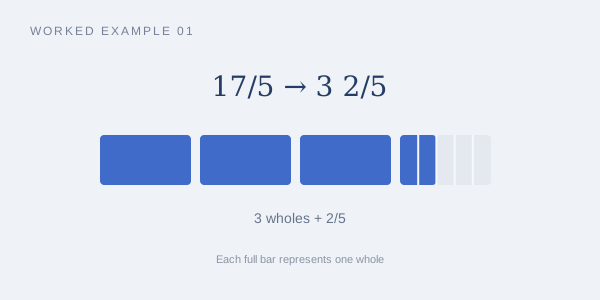
01Separate complete wholes
Seventeen fifths contain three groups of five fifths, with two fifths left over. The quotient is three and the remainder is two.
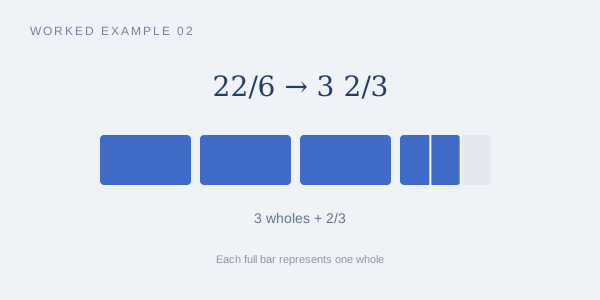
02Reduce the remainder
Twenty-two sixths make three wholes and four sixths. Four sixths reduce to two thirds; the final mixed number is three and two thirds.
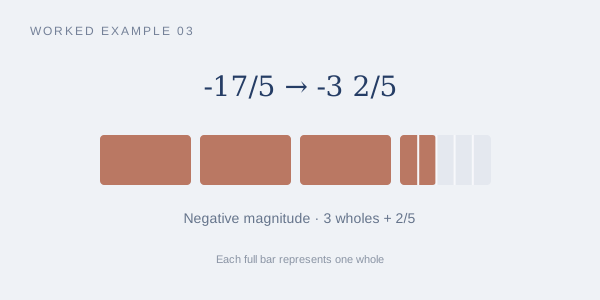
03Keep the negative sign
Convert the magnitude seventeen fifths first, then place the minus sign before the entire mixed number. The result means negative three and two fifths.
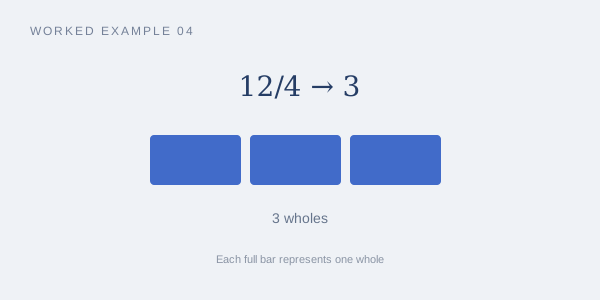
04Recognize an integer
Twelve fourths contain exactly three complete groups of four. There is no fractional remainder, so the cleanest answer is simply three.
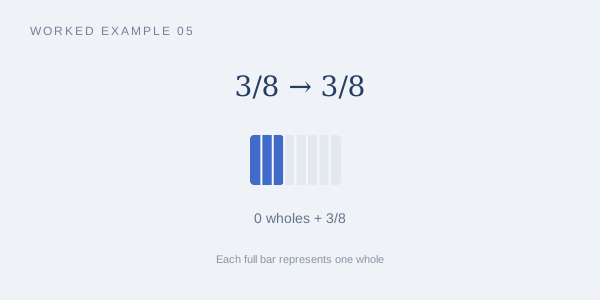
05Handle a proper fraction
Three eighths contain no complete whole. The value stays three eighths rather than acquiring an unnecessary zero whole-number part.
What an improper fraction represents
An improper fraction has a numerator at least as large as its positive denominator. It can represent one whole, several wholes, or several wholes with a remainder. The word improper describes the notation, not an error. Seventeen fifths is a valid exact number, and it is often more convenient than a mixed number when you multiply or divide.
A mixed number separates the same quantity into complete wholes and a proper fraction. Converting between the two forms does not change its position on the number line. Use the improper fraction to mixed number calculator when a worksheet requests mixed notation, when a measurement is easier to read in whole units, or when you want to understand how many complete groups a fraction contains.
Divide the numerator by the denominator
The conversion starts with integer division. For a positive numerator n and denominator d, find a quotient q and remainder r such that n = q × d + r, with r smaller than d. The quotient becomes the whole-number part. The remainder becomes the new numerator. The denominator stays d because the fractional pieces have not changed size.
For 17/5, five fits into seventeen three times, leaving two. Write 3 2/5. Notice that the remainder is two pieces of size one fifth, not two tenths and not the decimal 0.2. The improper fraction to mixed number calculator displays the division statement so you can see precisely where the whole part and fractional part came from.
Simplify without changing the value
An input does not have to be in lowest terms. You can reduce it before dividing or reduce its fractional remainder afterward; both methods lead to the same final value. For 22/6, dividing first gives 3 4/6. Reducing four sixths by their common factor of two gives 3 2/3. Reducing the original fraction to 11/3 before division produces that answer directly.
The tool normalizes the fraction before presenting the quotient and remainder. Consequently, its displayed division may use smaller numbers than your original input. That is expected, not a missing whole-number part. To check the transformation, multiply the original numerator and denominator by the same factor in reverse, or cross-multiply the original fraction and the reduced fraction to verify equality.
Negative inputs and denominator signs
A leading minus sign belongs to the entire value. The mixed form of -17/5 is -3 2/5, meaning -(3 + 2/5). It does not mean -3 + 2/5. First work with the absolute numerator to find the complete wholes and remainder, then restore the sign. This convention keeps the fractional remainder positive and makes the displayed mixed notation predictable.
A negative denominator is accepted and moved into the overall sign. Thus 17/-5 has the same result as -17/5, while -17/-5 becomes positive. A denominator of zero is never valid. The improper fraction to mixed number calculator reports that error instead of returning an infinity symbol or inventing a mixed number for an undefined expression.
Check the answer by converting back
A useful check is to rebuild the improper fraction from the mixed result. Multiply the whole-number part by the denominator, then add the fractional numerator. For 3 2/5, calculate 3 × 5 + 2 = 17 and keep the denominator five. You recover 17/5. Apply the original sign to the complete numerator when checking a negative answer.
An estimate offers another check. Seventeen fifths lies between fifteen fifths and twenty fifths, so its mixed form must lie between three and four. A result of two and two fifths would fail that simple bound even if some of the arithmetic looked plausible. Use the exact reverse calculation and the size estimate together when you are learning this conversion.
Know when another representation is clearer
A fraction that divides evenly becomes an integer. Twelve fourths is three, and writing 3 0/4 would add information that the reader does not need. A fraction smaller than one remains a proper fraction. Three eighths could be written 0 3/8, but the zero is normally omitted. Zero divided by a nonzero denominator is simply zero.
Mixed notation is especially useful for measurements expressed in whole units and fractional pieces. Improper notation is usually easier for fraction multiplication and division. A decimal may suit a digital measuring device, but a repeating decimal can be less concise than an exact fraction. The three answer forms help you choose a useful representation while keeping the underlying quantity unchanged.
Common questions
Does the numerator have to be larger than the denominator?
No. This improper fraction to mixed number calculator also handles equal numerators and denominators, proper fractions, and zero. Equal positive numerator and denominator give one. A proper fraction stays a proper fraction because it has no complete whole to separate. These cases make the conversion rule consistent across all valid fraction inputs.
Why is my denominator different in the answer?
The fractional remainder is simplified. A denominator changes only when numerator and denominator share a factor that can be removed from both. For example, 4/6 becomes 2/3. The size of the represented quantity stays the same even though the number and size of the pieces change.
Can I enter a decimal here?
This focused tool requires a fraction with a slash, such as 17/5. If your starting value is 3.4, use the decimal to mixed number calculator. It explains the place-value step needed to turn the decimal into a fraction before separating the whole-number part.
Why does the result include other answer forms?
The mixed number is the primary answer. The fraction is useful for checking equality or continuing an arithmetic problem, and the decimal helps estimate size. Parentheses mark repeating decimal digits; an ellipsis means the displayed decimal was shortened. The exact fraction and mixed number are not rounded.