Five examples, five useful ideas.
Follow each exact result, then try the same pattern with your own numbers.
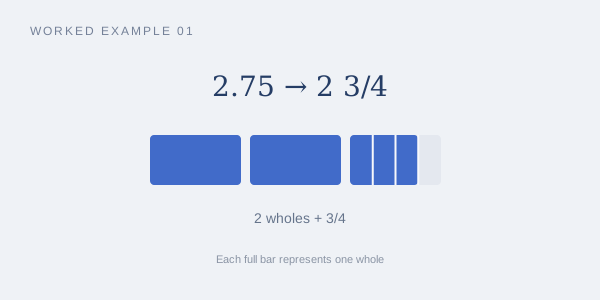
01Convert hundredths
The fractional part is seventy-five hundredths. Reduce 75/100 to 3/4, then place it after the two whole units.
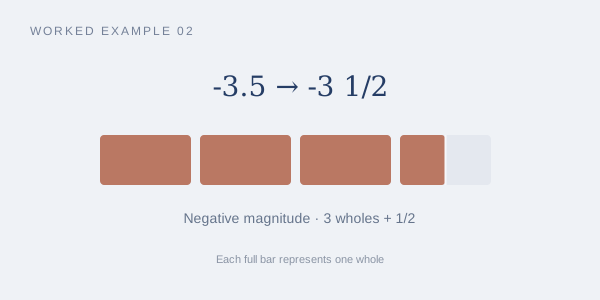
02Keep a leading negative sign
The magnitude is three and five tenths. Reduce five tenths to one half and restore the minus sign before the entire mixed number.
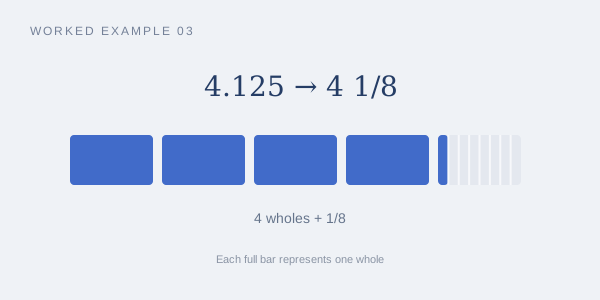
03Convert thousandths
The digits 125 represent 125/1000. Dividing both parts by 125 gives one eighth, so the mixed number is 4 1/8.
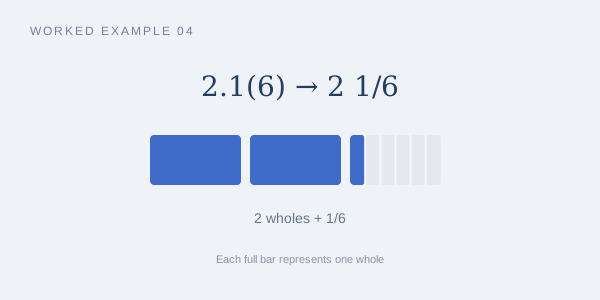
04Handle a repeating block
The fractional decimal 0.1666… equals one sixth. Parentheses tell the tool that the six repeats forever rather than ending after one digit.
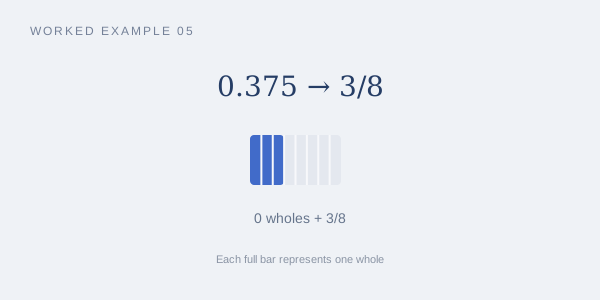
05A value below one
There are no complete wholes. The fractional value 375/1000 simplifies to 3/8, and the unnecessary zero whole part is omitted.
Start with decimal place value
A terminating decimal can be written as an integer divided by a power of ten. One decimal place means tenths, two means hundredths, and three means thousandths. For 2.75, remove the decimal point to obtain 275 and put it over 100. The fraction 275/100 reduces to 11/4, which separates into two wholes and three fourths.
You can also keep the whole part aside and convert only the decimal part. In that approach, 2.75 becomes 2 + 75/100, then 2 + 3/4. The decimal to mixed number calculator shows the exact fraction and the final mixed form so that either method is easy to check. Both methods preserve the same original number.
Reduce the fractional part completely
Find the greatest common divisor of the numerator and denominator, then divide both by it. For 125/1000, that divisor is 125, giving 1/8. A fraction is in lowest terms when no integer greater than one divides both parts. The whole-number part is kept separate when you simplify only the fractional remainder.
Trailing zeroes do not affect the result. The inputs 2.75, 2.750, and 2.7500 all represent the same rational value, even though their initial powers of ten differ. The decimal to mixed number calculator reduces each to 2 3/4. If your decimal came from a measurement, trailing zeroes may communicate measurement precision in another context, but they do not change this numerical conversion.
Enter repeating decimals explicitly
A finite entry and a repeating entry are different exact numbers. Typing 0.333 means precisely 333/1000. Typing 0.(3) means one third because the three repeats forever. Use parentheses only around the repeating block. In 2.1(6), the one occurs once and the six continues indefinitely. In 2.(16), both digits repeat together.
To understand the conversion, let x equal 0.1(6). Then 10x is 1.(6) and 100x is 16.(6). Subtracting the first equation from the second gives 90x = 15, so x = 1/6. Include the two whole units to obtain 2 1/6. The tool performs the equivalent integer calculation without approximating the infinite expansion.
Handle negative values and numbers below one
For a negative decimal, convert its absolute value and then restore the leading minus sign. The number -3.5 becomes -3 1/2, meaning negative three and one half. It does not become negative three plus positive one half. A single sign before the complete mixed notation makes this distinction visible and follows the same convention as the other fraction tools.
A value between zero and one has no complete whole-number part. The input 0.375 therefore produces 3/8 rather than 0 3/8. A negative value such as -0.375 produces -3/8. An integer input such as 4.0 produces four. These are useful boundary cases of the same conversion rule, not errors or reasons to force an unnecessary fractional remainder.
Do not infer an intended fraction from rounded digits
A decimal copied from a display may already have been rounded. If a device shows 1.67, this tool converts that exact written value to 1 67/100. It cannot know whether the original quantity was 1 2/3, 1.668, or another value that rounds to the same display. Exact conversion describes the supplied digits; it does not recover lost information.
If you know that a decimal repeats, enter the recurring block using parentheses. If you only know a rounded measurement, keep its stated uncertainty or precision in your final interpretation. Avoid changing 0.333 to one third merely because the digits look familiar. Those numbers are close, but their difference can matter in later calculations that require exact equality.
Check the mixed answer by dividing
Convert the mixed result back to a decimal by dividing its fractional numerator by its denominator and adding the whole part. For 4 1/8, one divided by eight is 0.125, giving 4.125. For a negative answer, apply the sign to the complete total. This reverse operation is a direct check that no place-value zero was lost.
You can also compare the answer with neighboring integers. A positive input of 4.125 should produce a mixed number between four and five. Its fractional part should be small, since 0.125 is close to zero. If your result has a whole part of forty-one or a remainder larger than one, revisit the decimal point placement and the power-of-ten denominator.
Common questions
Can this decimal to mixed number calculator convert repeating decimals?
Yes. Enter 2.1(6) for two point one followed by repeating sixes, or 0.(142857) for the repeating six-digit block of one seventh. Parentheses are required to distinguish an infinite repetition from a decimal that simply ends after the written digits. Use a decimal point before the fractional digits.
Why is 0.333 not converted to 1/3?
The finite decimal 0.333 is exactly 333/1000, while one third is 0.(3). The difference is one three-thousandth. The tool preserves the value of your actual input rather than guessing an intended fraction. Add repeating parentheses only when the source number truly repeats.
Can I use a comma as the decimal separator?
Use a point, such as 2.75. Commas, thousands separators, scientific notation, and percent signs are not accepted in this field. If your source says 275 percent, first interpret it as the decimal 2.75 before converting. This keeps the input grammar simple and the represented quantity explicit.
What happens to a decimal with no fractional part?
The result is an integer. For example, 7.000 becomes seven because its fractional remainder is zero. A mixed number is useful only when both a whole part and a nonzero fractional part exist; the calculator omits unnecessary zero pieces while still showing an exact fraction-compatible value.