Five examples, five useful ideas.
Follow each exact result, then try the same pattern with your own numbers.
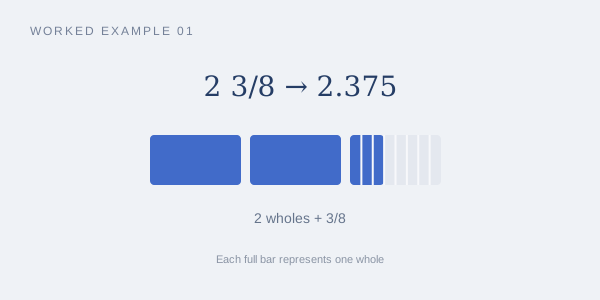
01A terminating decimal
Three divided by eight is 0.375. Adding the two complete wholes gives 2.375, with no rounding required.
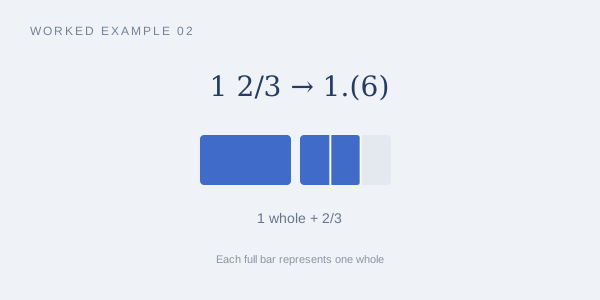
02A repeating decimal
Two thirds is 0.666… forever. Parentheses identify the recurring digit, so 1.(6) represents the exact repeating expansion.
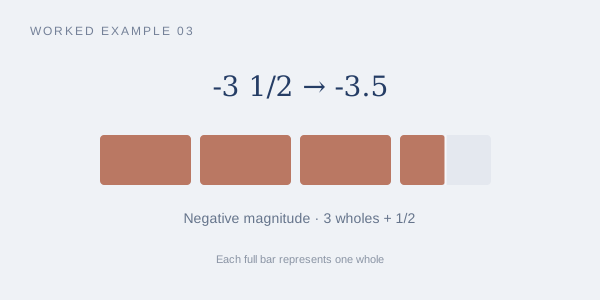
03A negative mixed number
The sign applies to three and one half together. Its magnitude is 3.5, and the final decimal is -3.5.
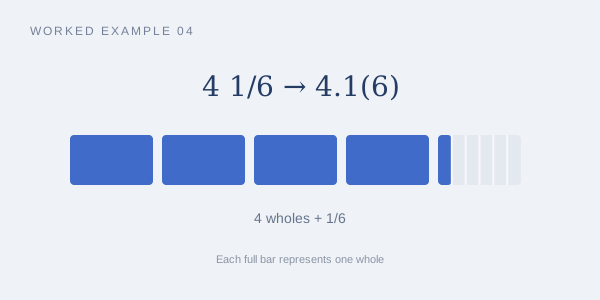
04A nonrepeating prefix
One sixth begins with a one and then repeats six. Only the six belongs inside parentheses: 4.1(6).
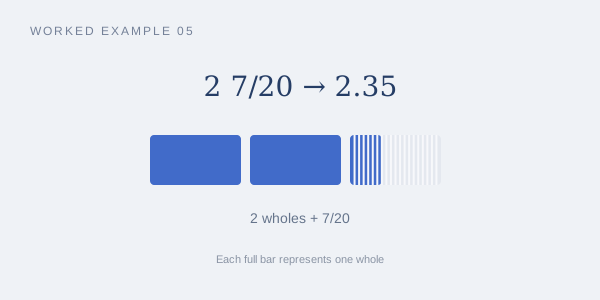
05Hundredths after scaling
Seven twentieths can be renamed thirty-five hundredths. Add the two wholes to obtain 2.35 exactly.
Divide the fractional part, then include the whole part
A mixed number combines a whole part with a proper fraction. To express it as a decimal, divide the fractional numerator by its denominator and add the whole-number part. For 2 3/8, three divided by eight is 0.375, so the complete value is 2.375. You may instead convert the mixed number to 19/8 and divide nineteen by eight.
Both approaches give the same decimal because they describe the same rational number. The mixed number to decimal calculator uses exact integer arithmetic to preserve that value before producing its decimal expansion. It does not first turn your input into an approximate binary floating-point number. This distinction matters when many digits or repeating fractions are involved.
Recognize decimals that end
Some fractions have a finite decimal expansion. After reducing a fraction to lowest terms, its denominator produces a terminating decimal precisely when its prime factors are only twos and fives. These factors can be matched to a power of ten. Eighths, twentieths, and hundredths all fit this pattern, while thirds and sevenths do not.
For 2 7/20, multiply seven and twenty by five to obtain thirty-five hundredths. The decimal is 2.35, and adding trailing zeroes such as 2.350 does not change its value. The mixed number to decimal calculator marks a fully displayed terminating answer as exact. That label describes the mathematical representation, not the accuracy of a physical measurement that you might enter.
Read repeating digits correctly
Long division repeats when a remainder appears for a second time. From that point, the same division steps produce the same block of digits indefinitely. Parentheses identify this repeated block: 1.(6) means 1.666… forever. In 4.1(6), the initial one is not part of the repeating block; only the six repeats.
A repeated block can contain more than one digit. One seventh is 0.(142857), so two and one seventh is 2.(142857). Do not interpret parentheses as multiplication or as a rounded last digit. They are a compact notation for an infinite but exact expansion. The fraction beside the decimal remains a convenient alternative when you need to copy a value into another calculation.
Distinguish a shortened display from rounding
The decimal display is limited to sixty fractional digits. If the expansion has not ended or completed a detectable cycle within that space, the tool appends an ellipsis. That display is shortened, not an assertion that all remaining digits are zero. The exact fraction stays available and is the appropriate value to use when precision must be preserved.
This tool does not offer a selectable rounding-place control. To round manually, choose the required number of decimal places and inspect the next digit. For example, 2.375 rounds to 2.38 at two decimal places using the usual school rule. Keep the unrounded value in intermediate work and round only when the final task asks for an approximation.
Keep the sign of the entire mixed number
The entry -3 1/2 means -(3 + 1/2), so its decimal is -3.5. It does not mean negative three plus positive one half, which would equal -2.5. Working with the positive magnitude first and then restoring the sign is a reliable way to avoid this common notation error. Put one minus sign at the beginning of the input.
A negative decimal lies to the left of zero on the number line. As the magnitude of its fractional part increases, it moves farther left. Thus -3.75 is smaller than -3.5 even though seventy-five is larger than fifty. If you are comparing signed measurements or balances, check both the sign and the size rather than comparing fractional digits alone.
Choose a representation suited to the next task
Decimals are useful for place-value comparisons, digital measurements, and systems that expect a decimal point. Fractions are useful when a value repeats or when you want to keep a ratio exact. Neither form automatically tells you how accurately an original measurement was made. Converting a measured 2 1/2 units to 2.500000 does not create additional measurement precision.
To check a terminating result, separate its whole part and write its decimal digits over the corresponding power of ten. The result 2.375 becomes 2 + 375/1000, and reducing the fraction returns 2 3/8. For a repeating decimal, use the dedicated decimal-to-mixed tool with parentheses around the repeated block. It reconstructs the exact rational value rather than treating a few written digits as the whole expansion.
Common questions
Why does my decimal contain parentheses?
Parentheses mark digits that repeat forever. The mixed number to decimal calculator writes 1 2/3 as 1.(6), not as the finite decimal 1.6. This notation keeps a repeating expansion exact while avoiding an endless string of digits. An ellipsis without a completed repeating block instead indicates a shortened display.
Can I convert a simple fraction here too?
Yes. You may enter 3/8 without a whole-number part, and the answer is 0.375. Whole numbers are also accepted. The focused examples use mixed numbers, but the same division rule applies to every valid rational input, including values smaller than one and negative values.
Why does 2 2/6 terminate or repeat like 2 1/3?
Two sixths reduces to one third, so both mixed inputs are exactly equal and both produce 2.(3). Check the reduced denominator when predicting whether a decimal will terminate. Factors that cancel with the numerator do not determine the final decimal pattern.
Can I copy the exact value into another tool?
Use the fraction shown beside the decimal if the receiving tool does not support repeating parentheses. A finite string such as 1.666667 is only an approximation to 1 2/3. Keeping 5/3 preserves the exact value through later multiplication, division, or comparison.