Five examples, five useful ideas.
Follow each exact result, then try the same pattern with your own numbers.
01Add unlike denominators
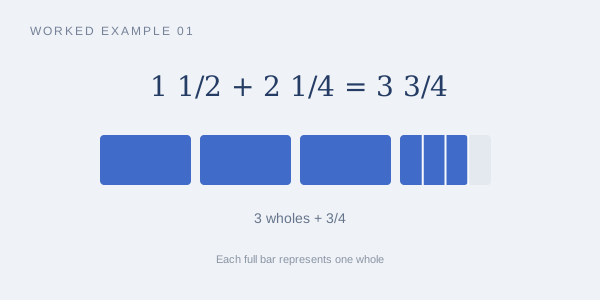
Rename one half as two quarters. Add the whole parts to get three and the fractional parts to get three quarters.
02Carry a complete whole
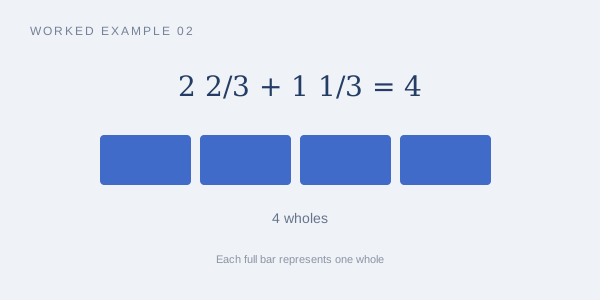
Two thirds plus one third makes one complete whole. Add that whole to the original three whole units to obtain four.
03Carry with a remainder
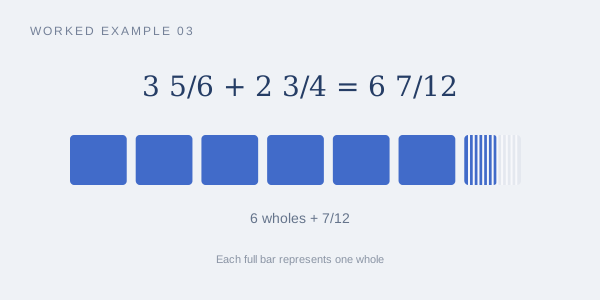
Ten twelfths plus nine twelfths makes nineteen twelfths, or one and seven twelfths. Add the extra whole to the five whole units.
04Combine opposite signs
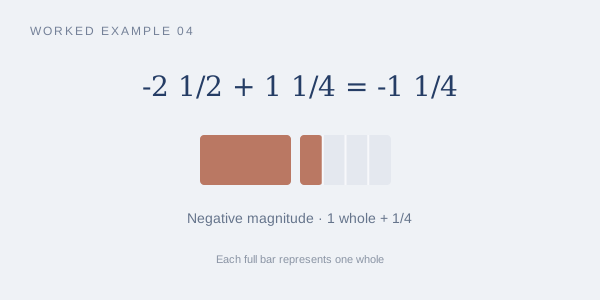
Negative ten quarters plus positive five quarters leaves negative five quarters. The mixed sum is negative one and one quarter.
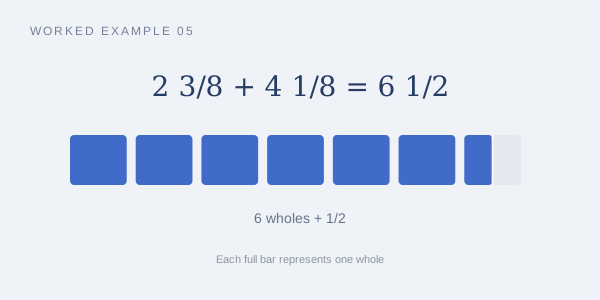
05Reduce after adding
The denominators already match. Three eighths plus one eighth is four eighths, which reduces to one half; the whole parts add to six.

Addition combines quantities measured in the same unit
Adding mixed numbers means finding the total of quantities that each contain complete units and fractional pieces. Before using arithmetic, check that the quantities refer to the same unit and the same-sized whole. Two and one half metres can be added to one and one quarter metres directly. A measurement in metres and another in centimetres first need a unit conversion.
The adding mixed numbers calculator handles the numerical part after you choose consistent units. It accepts mixed numbers, ordinary fractions, whole numbers, and signed values in its two fields. The operation is fixed to addition on this page, so the examples and explanation stay focused on sums. Use the parent mixed-fraction tool if you need to combine three quantities in a single calculation.
Find a common denominator for unlike fractions
The denominators identify piece sizes. Halves and quarters cannot be counted together as though each piece were identical. Rename them using a common denominator first. For 1 1/2 + 2 1/4, the least common denominator is four, and one half becomes two quarters. The fractional addition is then 2/4 + 1/4 = 3/4.
Any common multiple of the denominators can produce a valid answer, but the least common denominator usually keeps the working smaller. For sixths and fourths, twelve is more efficient than twenty-four. Multiplying a numerator by the same factor as its denominator preserves the fraction. Changing only the denominator would change the quantity, which is why both parts must be scaled together.
Add whole parts and carry when necessary
When both inputs are positive, you can add whole parts separately and then add the renamed fractional parts. If the fractional sum reaches or exceeds one, move its complete whole into the whole-number total. In 2 2/3 + 1 1/3, the fractions add to 3/3, which is one. The original whole parts add to three, so the final answer is four.
A fractional sum may leave a remainder after carrying. For 3 5/6 + 2 3/4, use twelfths: ten twelfths plus nine twelfths is nineteen twelfths. That is one whole and seven twelfths. Add the carried whole to three plus two to obtain 6 7/12. Forgetting that extra whole produces an answer that is exactly one unit too small.
Use improper fractions for a consistent alternative
Converting both inputs to improper fractions gives a method that works smoothly for positive and negative values. The input 1 1/2 becomes 3/2, and 2 1/4 becomes 9/4. Rename three halves as six quarters, then add six and nine to obtain 15/4. Dividing fifteen by four gives three with remainder three, returning 3 3/4.
The adding mixed numbers calculator uses this unified approach in its working. It avoids needing a different algorithm whenever signs or whole-number sizes change. You can still compare its steps with the whole-parts-first method from a lesson. Both methods must arrive at the same reduced fraction, because each step preserves the value of the original quantities.
Interpret sums that include a negative mixed number
A negative mixed number has one leading sign that applies to the whole quantity. The entry -2 1/2 means negative five halves. Adding 1 1/4 gives -10/4 + 5/4 = -5/4, or -1 1/4. The positive quantity cancels part of the negative quantity, but it is not large enough to move the total above zero.
With two negative inputs, add their magnitudes and keep the negative sign. With opposite signs, compare magnitudes to predict the sign before calculating. This is a useful check: adding a smaller positive quantity to a larger negative quantity should still leave a negative result. Do not attach the minus sign only to the whole-number part and leave its fractional part positive.
Check a sum using estimates and subtraction
For positive inputs, the sum should be at least as large as either input. Round or bracket each mixed number to estimate the total before trusting a copied answer. The sum of 3 5/6 and 2 3/4 should be close to seven and greater than six. The exact answer 6 7/12 fits those bounds, while 5 7/12 would reveal a missed carry.
Subtraction provides an exact inverse check. Subtract either addend from the calculated sum; the result should equal the other addend. From 3 3/4, subtract 2 1/4 to recover 1 1/2. Keep fractions exact while checking rather than converting everything to rounded decimals. A small discrepancy introduced by decimal rounding can otherwise look like an arithmetic mistake.
Common questions
Do I add the denominators too?
No. A common denominator describes the size of every piece being counted and remains unchanged during addition. Only the numerators are added after the fractions have equal denominators. The adding mixed numbers calculator displays the renamed fractions first so you can see why adding the original denominators would give a different and incorrect quantity.
Can the sum be a whole number?
Yes. Fractional parts can complete a whole exactly, as in 2 2/3 plus 1 1/3. The result is four, with no fractional remainder. The calculator omits a zero fractional part instead of writing an unnecessary mixed expression such as 4 0/3.
How do I add three mixed numbers?
Open the mixed fraction calculator and choose Add a third number. Addition can be grouped in any order without changing the exact sum. Combine two inputs, then add the third, keeping the fractional values exact. This focused page uses two inputs so its examples remain easy to compare with a two-addend exercise.
Why does the final fraction have a smaller denominator?
The sum is reduced to lowest terms. For example, 3/8 plus 1/8 is 4/8, which simplifies to 1/2. Reducing numerator and denominator together preserves the quantity. A changed denominator after simplification is different from incorrectly adding denominators during the arithmetic step.