Five examples, five useful ideas.
Follow each exact result, then try the same pattern with your own numbers.
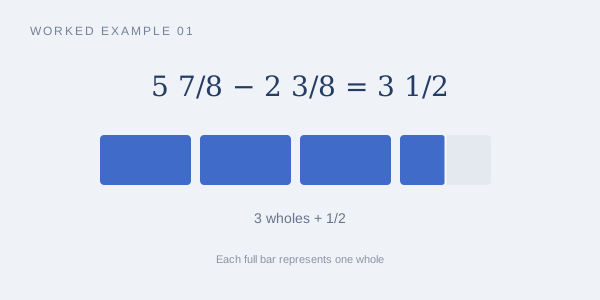
01No borrowing needed
Seven eighths is greater than three eighths, so subtract the parts directly. Three wholes and four eighths simplify to three and one half.
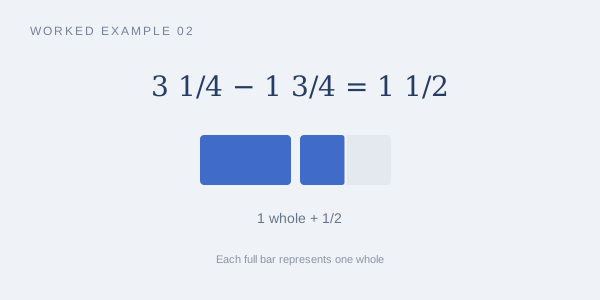
02Borrow one whole
Rename three and one quarter as two and five quarters. Subtract one and three quarters to obtain one and two quarters, or one and one half.
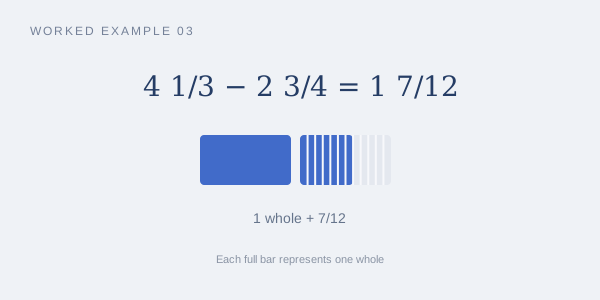
03Unlike denominators and borrowing
Use twelfths, then regroup four and four twelfths as three and sixteen twelfths. Removing two and nine twelfths leaves one and seven twelfths.
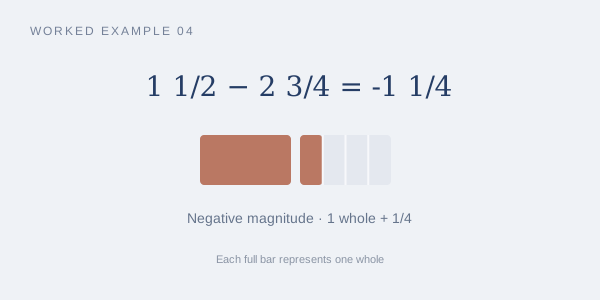
04A negative difference
Six quarters minus eleven quarters is negative five quarters. The first quantity is smaller, so the negative result is expected.
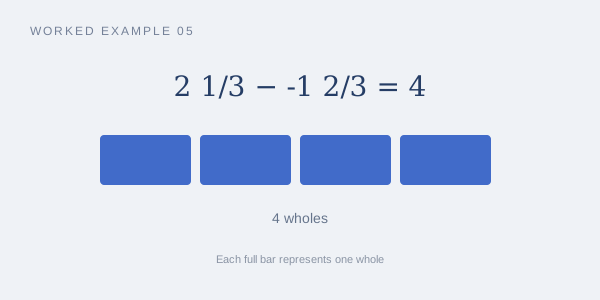
05Subtract a negative
Removing a negative quantity is equivalent to adding its positive magnitude. Seven thirds plus five thirds makes twelve thirds, or four.

The order of subtraction matters
Subtraction finds a difference in a specified order. In a − b, a is the starting quantity and b is the quantity subtracted. Reversing the inputs generally changes the sign of the answer. For example, 3 1/4 − 1 3/4 is positive, while 1 3/4 − 3 1/4 is negative. Check the order before entering a worksheet or measurement problem.
The subtracting mixed numbers calculator labels the two inputs and displays the selected expression beside the result. Use consistent measurement units before calculating. Subtracting metres from metres is meaningful; subtracting a numerical count of centimetres from metres without converting units is not. The tool handles the arithmetic but cannot infer which real-world units your numbers represent.
Match denominators before comparing fractional parts
To subtract fractional pieces, first give them the same size. For 4 1/3 − 2 3/4, use a denominator of twelve. One third becomes four twelfths, and three quarters becomes nine twelfths. You can now compare four pieces with nine pieces directly. Comparing only the original numerators one and three would ignore their different denominators.
Use the least common multiple of the denominators to keep the arithmetic compact. Multiply each numerator by the same factor used on its denominator. Once both denominators match, subtract numerators while keeping that common denominator. Do not subtract the denominators themselves: they describe the unit piece and must remain consistent throughout the subtraction step.
Borrow one whole when the first fractional part is smaller
For a nonnegative difference, borrowing is needed in the whole-parts-first method when the first fractional part is smaller than the second. One whole equals d/d when the common denominator is d. Reduce the first whole part by one and add d to its fractional numerator. This changes the notation without changing the total starting amount.
In 3 1/4 − 1 3/4, rewrite the first number as 2 5/4. You can now subtract three quarters from five quarters and one whole from two wholes. The result is 1 2/4, which reduces to 1 1/2. The subtracting mixed numbers calculator includes a regrouping statement when this positive borrowing case occurs, alongside its general improper-fraction method.
Use improper fractions to avoid separate borrowing
The improper-fraction method turns every complete whole into fractional pieces before subtracting. Three and one quarter becomes 13/4, while one and three quarters becomes 7/4. Subtracting gives 6/4, or 3/2, which is 1 1/2. Borrowing is already accounted for because all pieces were combined into the numerator at the beginning.
This method is particularly convenient when the answer is negative or one input already has a negative sign. It follows the same rules regardless of the relative whole-number parts. The two methods are not competing definitions of subtraction. They are different ways to organize equivalent quantities, and comparing them can help you understand why regrouping preserves the starting number.
Handle negative differences and negative subtrahends
If the second input is larger than the first, the difference is negative. For 1 1/2 − 2 3/4, use quarters to obtain 6/4 − 11/4 = -5/4. The mixed answer is -1 1/4. You do not need to force a positive borrowing procedure onto this situation; signed improper fractions provide a direct and reliable calculation.
Subtracting a negative is different from subtracting a positive. The expression 2 1/3 − (-1 2/3) becomes 2 1/3 + 1 2/3, which equals four. Keep the second input negative in its field and leave the page operation as subtraction. Changing both the input sign and the intended operation accidentally would undo the sign change you need.
Verify the difference by adding back
An exact check is to add the subtracted quantity back to the difference. The result should recover the first input. If 4 1/3 − 2 3/4 equals 1 7/12, then 1 7/12 + 2 3/4 must equal 4 1/3. This inverse check is especially useful after borrowing, where a missed change to the whole part can cause an error of one.
Also estimate the size and sign. Subtracting a value near three from a value a little above four should leave a result near one and a half. A result above four would be implausible for two positive inputs in that order. When the second quantity is negative, however, the result can exceed the first; the sign rule changes that expectation.
Common questions
When do I need borrowing?
After finding a common denominator, compare the fractional numerators. If the first is smaller and the overall difference is nonnegative, regroup one whole into denominator-sized fractional pieces. The subtracting mixed numbers calculator shows that exchange explicitly. If you work entirely with improper fractions, you can obtain the same result without a separate borrowing step.
Can I subtract the whole parts first?
Yes, provided you account correctly for the fractional difference and any borrowed whole. The usual classroom method works cleanly for positive inputs with a nonnegative result. For signed values or a smaller first input, converting to improper fractions often avoids confusing intermediate negative fractional parts.
Why is the answer negative?
A negative difference means the second quantity exceeds the first in the specified subtraction order. It is a valid result, not an error. For example, one and one half minus two and three quarters is negative one and one quarter. Reverse the inputs only if the original problem asks for the opposite order.
Does subtracting equal mixed numbers give a zero fraction?
It gives zero. Equivalent inputs also cancel, even if written differently: 2 1/2 and 2 2/4 represent the same value. The tool reduces both before arithmetic and displays a clean zero result without an unnecessary denominator or whole-number-plus-zero-fraction expression.