Five mixed number to percent examples
Follow each exact result, then try the same pattern with your own numbers.
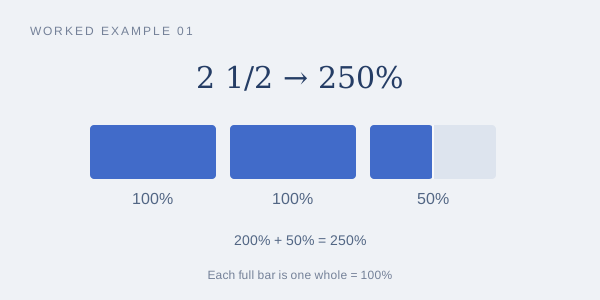
01Two and a half
Two wholes contribute 200%, and the remaining half contributes 50%. Together they make 250%. This mixed number to percent example shows why an answer above 100% is expected: the original number is greater than one, rather than a small part of one.
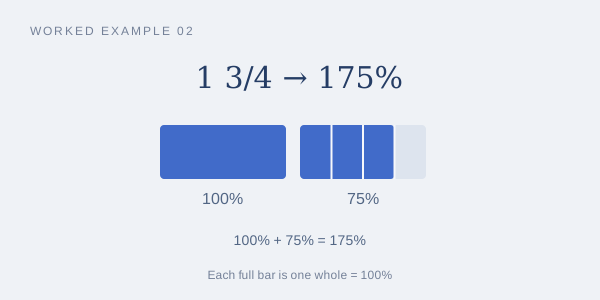
02Quarters become hundredths
One whole is 100%. Three quarters are 75 hundredths, so the fractional part adds 75%. The exact result is 175%, with no rounding required. You can also write 1 3/4 as 7/4 and calculate 700 divided by 4 to reach the same answer.
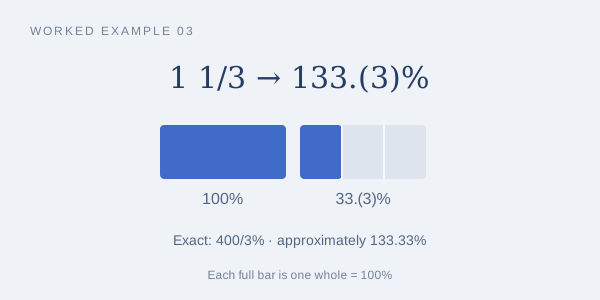
03A repeating percentage
The fraction 4/3 becomes 400/3 percent. Its decimal percentage is 133.(3)%, where the digit in parentheses repeats forever. To two decimal places it is approximately 133.33%. Keep the exact value until your final step, particularly if another calculation will use the result.
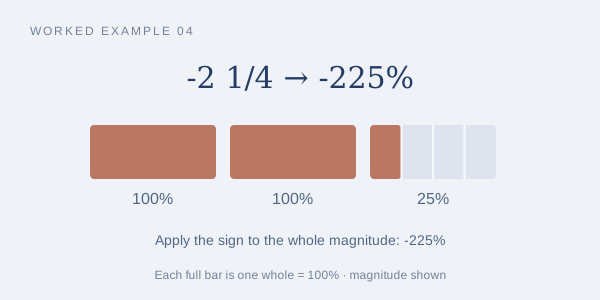
04Keep the negative sign
The minus sign applies to both the two wholes and the quarter: -(2 + 1/4). Multiplying -9/4 by 100 gives -225%. This is a signed quantity, not a share of a physical collection. The magnitude diagram uses the same-sized whole for every bar.
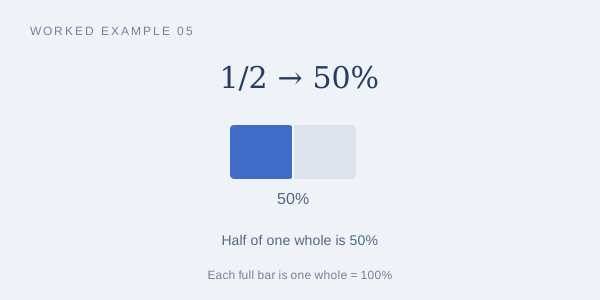
05Less than one whole
A proper fraction works too. Half of one whole is 50%, so a number between zero and one produces a percentage between 0% and 100%. You do not have to add a leading zero; either 1/2 or 0 1/2 represents the same input.
How to convert a mixed number to a percent
A mixed number combines a whole-number part and a fractional part. In 2 3/8, the space means addition: two plus three eighths. For a positive mixed number w n/d, first calculate w × d + n. Put that total over d, then multiply the fraction by 100 and attach the percent sign. The denominator must not be zero.
For example, 2 3/8 becomes (2 × 8 + 3)/8 = 19/8. Multiplying by 100 gives 1900/8 = 475/2, so the answer is exactly 237.5%. The mixed number to percent calculator keeps the calculation as a fraction internally, which avoids rounding the intermediate decimal before multiplying.
If you want to practice the first step separately, use the mixed number to improper fraction calculator. Both representations describe the same quantity; converting the notation does not increase or decrease it.
Using the mixed number to percent calculator
Type the whole part, a space, and the fraction with a slash. For instance, enter 3 2/5 for three and two fifths. Press Convert to percent to update the result and working. The example buttons fill the input and calculate immediately. Fractions, integers, terminating decimals, and repeating decimals such as 0.(3) are also accepted.
Enter the numerical value without a percent sign. A message explains invalid inputs instead of silently changing them. If you edit a number, the previous result stays visible with a warning until you calculate again; copying is disabled during that interval. This helps prevent copying the answer to an earlier question.
The main result preserves a detected repeating block. The exact percent underneath remains available even when a long decimal preview is shortened. Choose the percent decimal places separately for a worksheet or form, and use the corresponding copy button. That choice never changes the exact calculation.
Why the answer can be greater than 100%
Percent means per hundred. One whole is 100/100, or 100%; two wholes are 200/100, or 200%. Consequently, a positive mixed number with at least one whole and a nonzero fraction must convert to more than 100%. Nothing about the definition restricts a percentage to the interval from zero to one hundred.
When converting a mixed number to percent, keep the reference whole consistent. If a container holds 1 3/4 times a reference amount, it holds 175% of that reference amount. This is 75% more than the reference, not a 175% increase. The percentage of an original amount and the percentage increase answer different questions.
Separate the whole and fractional contributions
Another mixed number to percent method converts each part independently. For 3 2/5, three wholes contribute 300%, and two fifths contribute 40%. Add those contributions to get 340%. This method is useful for estimating: with a proper positive fractional part, the answer must lie between 300% and 400%.
You can instead divide first: 3 2/5 = 3.4, then 3.4 × 100 = 340. The mixed number to decimal calculator explains that division in detail. Do not stop at 3.4%: attaching a percent sign to the unscaled decimal changes the value by a factor of one hundred.
Exact, repeating, shortened, and rounded results
A mixed number to percent conversion does not always produce a terminating decimal. For 1 1/6, the exact fraction percentage is 350/3%, also written 116.(6)%. The repeating notation is exact because it specifies every digit, even though only one repeating block is printed. It is different from the finite value 116.6%.
A preview that reaches sixty decimal places without finishing or detecting a complete cycle ends with an ellipsis. This is a shortened display, not a rounded answer. Use the exact fraction percentage for further work. The separate rounding control uses the full fraction, so it does not depend on the preview length.
At two decimal places, 116.(6)% becomes approximately 116.67%. The approximation symbol is included when copying a rounded value that differs from the exact result. Halfway values round away from zero: 12.345% becomes 12.35%, and -12.345% becomes -12.35%. Trailing zeroes indicate the selected precision, rather than extra certainty about a measured input.
Negative values and the meaning of the input
For a negative mixed number to percent conversion, apply the sign to the entire mixed number. The input -1 3/4 means -(1 + 3/4), so the answer is -175%. It does not mean -1 + 3/4. Write subtraction as a separate arithmetic task if that is what your problem requires.
The number 2 1/2 and the percentage 2 1/2% are also different. The first is 2.5 and converts to 250%. The second is already a percentage and equals 0.025 as a number. This converter handles the first task. Rejecting the percent sign protects against accidentally multiplying a percentage a second time.
Check a mixed number to percent answer
To check a mixed number to percent result, divide its numerical percent value by 100. For 237.5%, calculate 237.5 ÷ 100 = 2.375, which equals 2 3/8. An exact fraction check works without decimals: (475/2) ÷ 100 = 475/200 = 19/8. The result panel shows this reverse check for your input.
In a recipe, a scale factor of 1 1/2 means using 150% of each original ingredient. In a measurement comparison, first divide the measured amount by the reference amount to obtain a dimensionless ratio; only then express it as a percentage. Use the dividing mixed numbers calculator if those two quantities are mixed numbers. This page converts a value; it does not infer a missing reference amount.
Common questions
Can a mixed number percentage be negative?
Yes. Multiplying a negative number by positive 100 preserves its sign. For example, -1 1/4 converts to -125%. Whether a negative percentage makes sense depends on the quantity being described, such as a signed change rather than a physical share.
What is the mixed number to percent formula?
For a positive mixed number w n/d, use ((w × d + n) / d) × 100%. Apply a leading negative sign to the complete expression for a negative mixed number. The calculation requires a nonzero denominator.
How do I convert a mixed number into percent without a calculator?
Convert the whole part to hundreds of percent, then multiply the fractional part by 100 and add. For 4 1/5, use 400% + 20% = 420%. Fifths, quarters, halves, and tenths often make this mental method especially convenient.
Why is my rounded answer different from the exact answer?
Rounding replaces an infinite or longer decimal with a finite approximation. For example, 133.(3)% and approximately 133.33% describe an exact value and its two-place approximation. Increase the precision when appropriate, or keep 400/3% for exact arithmetic.
Does this tool calculate a percent increase?
No. A mixed number to percent conversion expresses one value per hundred. Percent increase needs both an original and a new amount, with their difference divided by the original amount. A final amount of 250% of the original corresponds to a 150% increase.